(2017) “A Kind of ‘in-between’: Jazz and Politics in Portugal (1958-1971)”
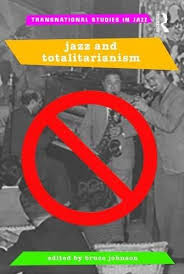
My first contribution to Routledge’s Transnational Studies in Jazz series, both as editor-advisor and an author, was Jazz and Totalitarianism, edited by Bruce Johnson. My chapter investigates the use of jazz music as protest against the Portuguese New State (Estado Novo) regime and its colonial policies (1958-1961), and as a symbol of freedom to configure new social realities in Portugal (1971-1974).
In 1958, Salazar, under international pressure, eased repression and promoted ‘free elections’ to give the illusion of a free country. In this context, students at the University of Lisbon founded the Clube Universitário de Jazz (CUJ; lit. University Jazz Club). The CUJ was closed by the Portuguese police in 1961 after the first signs of the independence/colonial war in Angola. In the following decade, during Caetano’s governance, Portugal hosted a significant international jazz event. It took place, the first edition of the Festival Internacional de Jazz de Cascais (Cascais International Jazz Festival). Although state-sponsored, the event became a space of political led by the North American bass player Charlie Haden and applauded by thousands attending the event, which led to the arrest of North American bass player the following day by the Portuguese Political Police (PIDE/DGS). My chapter analyses jazz as a social and musical practice in Portugal between these two important historical events.
Keywords: Jazz; Portugal; Estado Novo; Clube Universitário de Jazz; Festival Internacional de Jazz de Cascais; Charlie Haden; Resistance.
To cite this chapter: Cravinho, Pedro (2017). “10. A Kind of ‘in-between’: Jazz and Politics in Portugal (1958-1974)”. In Johnson, Bruce (Ed.), and Pedro Cravinho and Heli Reimann (Eds. advisors). Jazz and Totalitarianism, pp. 218–38. New York and London: Routledge.